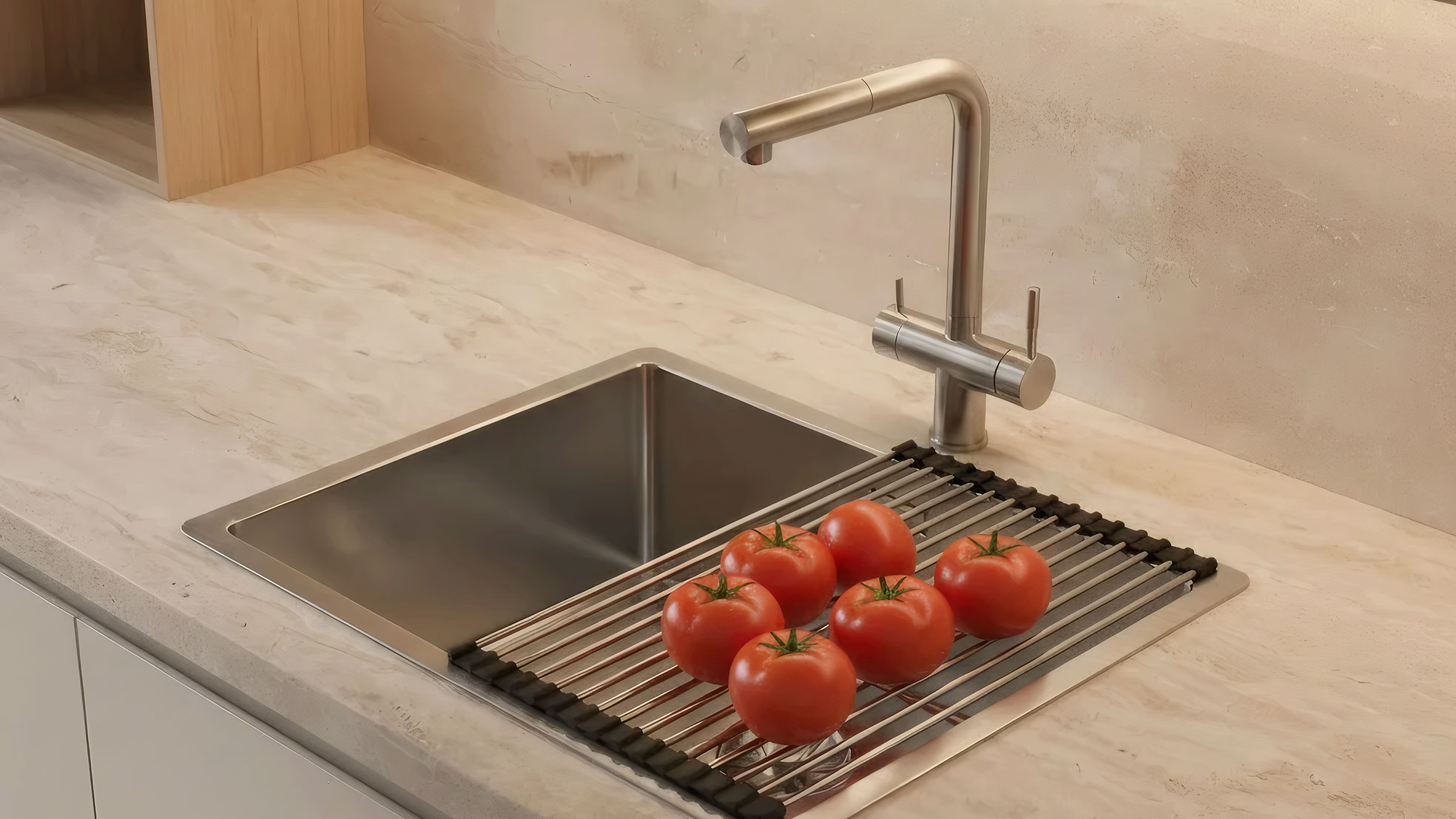
Choose a roll-up drainer if you want it to disappear into a drawer when not in use; it coils down to roughly 8-10cm in diameter, small enough for most utensil drawers. Choose a lay-on drainer if you regularly dry heavy cookware; its rigid grid won't flex or sag under a 4-5kg cast iron pan the way a roll-up's bars can. Both sit over the sink and free the same counter space when deployed. The difference is entirely in storage and what you put on them.
How Roll-Up Drainers Work
Roll-up drainers are parallel stainless steel bars connected by flexible silicone strips, letting the whole assembly coil into a cylinder for storage. Unrolled, the bars span the sink opening and rest on the basin edges, creating a slatted surface with typical bar spacing of 15-20mm, wide enough for water to drip through cleanly but close enough to hold most plates and bowls securely.
Rolled up, a standard-width drainer (sized for a 35-45cm sink opening) coils to roughly 8-10cm in diameter and 30-35cm in length, close to the size of a rolled magazine, small enough for a standard drawer.
Because there's no rigid frame, a roll-up drainer needs the sink edges for support and can't function as a standalone surface on a flat counter. The flexible silicone connections between bars are also the format's main wear point; they take repeated bending stress every time the drainer is rolled and unrolled.
How Lay-On Drainers Work
Lay-on drainers are flat, rigid or semi-rigid grids, typically stainless steel wire or a solid slotted panel, that span the sink without folding. Many include raised edges (usually 15-25mm high) to stop items sliding off, and some add integrated sections: a utensil holder, a cutting board slot, or a colander insert.
A lay-on drainer holds its shape independently of the sink, so it supports weight evenly across the panel rather than depending on bar tension. This is why a rigid lay-on grid rated for standard kitchen use (commonly 5-8kg distributed load) handles a full stack of dishes or a heavy pan without flexing, while a roll-up's bars can spread slightly under a concentrated point load.
Storage requires space for the full flat footprint, typically 35-45cm by 25-30cm for a standard single-bowl size, since the panel doesn't compress or fold.
Roll-Up vs. Lay-On: Quick Comparison
| Roll-Up | Lay-On | |
|
Storage form |
Coils to ~8-10cm diameter |
Flat, full footprint (~35-45 x 25-30cm) |
|
Storage location |
Drawer, cabinet, upright in a corner |
Leaning storage or left in place |
|
Bar/grid spacing |
15-20mm between bars |
Varies; often tighter grid or solid sections |
|
Weight handling |
Can flex under concentrated heavy loads |
Rigid; holds heavy cookware without sagging |
|
Water shedding |
Round bars shed water fast, dry quickly |
Flat slats can hold small pools; may need wiping |
|
Integrated features |
None (bars only) |
Utensil holders, cutting board slots, colander inserts possible |
|
Main wear point |
Silicone connections between bars |
Weld/joint integrity, finish durability |
|
Typical price band |
Lower to mid-range |
Mid-range to higher for multi-feature designs |
|
Best fit |
Limited storage, want it out of sight between uses |
Frequent heavy cookware, want integrated features |
Space and Storage
A roll-up drainer's defining advantage is disappearing completely: coiled to about 8-10cm across, it fits into a drawer alongside utensils rather than needing its own dedicated space. This suits kitchens with limited cabinet real estate but at least one free drawer.
A lay-on drainer needs storage matching its full flat size, commonly leaning against a cabinet interior or slid into a narrow gap beside an appliance. If the drainer stays on the sink permanently, which many households do, this difference doesn't matter: both formats free identical counter space while deployed, and storage size only becomes relevant if you actually remove it between uses.
Stability and Weight Handling
A quality lay-on drainer distributes weight across its full rigid panel, so a heavy pan sits as securely as it would on a countertop. A roll-up drainer's bars can flex under a concentrated load like a full stockpot, and the flexible silicone connections allow slight movement that a rigid grid doesn't have.
For lighter loads, rinsed produce, glasses, individual plates, both formats perform equivalently. The stability gap only shows up with heavy cookware or a fully loaded drying session.
Drainage
Round bars on a roll-up drainer shed water immediately since there's no flat surface for it to sit on, which also keeps the drainer itself dry between uses. Flat-panel lay-on drainers can hold small pools of water on horizontal sections unless the design includes a slight slope or drainage channels, meaning some lay-on models need an occasional wipe that a roll-up rarely does.
Both formats let water fall directly into the basin, which is the real advantage over a counter-standing rack that needs its own drip tray. Dishes dry at the same rate on either format; the difference is only in whether the drainer itself stays dry.
Versatility
A roll-up drainer doubles as an instant trivet: unroll it in seconds to set a hot pan safely above the sink. It also works as a temporary prep surface, a cutting board laid across the bars gives a stable-enough platform for most vegetable prep with a sink underneath for rinsing.
A lay-on drainer offers the same two functions with a firmer surface, since a rigid grid doesn't shift under cutting pressure the way flexible bars occasionally can. Lay-on formats are also the only ones that can incorporate built-in features like a colander section or a dedicated cutting board area, since those need a rigid frame to attach to.
Cleaning
Both formats are straightforward to clean; a simple roll-up or a basic-grid lay-on rinses clean under running water, and most are dishwasher safe. Complexity is what adds cleaning effort: a lay-on drainer with an integrated utensil holder or multi-section design has more joints and corners to check for buildup than either a plain roll-up or a simple flat grid.
Drying the drainer itself after use matters for both, since standing water leads to spotting or mineral deposits over time. A roll-up's sparse bar construction shakes dry in seconds; a lay-on drainer's larger surface area sometimes needs a quick towel pass to avoid water sitting in corners or along raised edges.
Durability
A roll-up drainer's lifespan depends almost entirely on its silicone connections, since those flex every time the drainer rolls and unrolls. Reinforced or thicker silicone joints hold up for years of daily use; thin, budget connections are the first thing to crack or tear.
A lay-on drainer doesn't face that specific rolling stress, so its durability comes down to weld and joint quality (on welded grid designs) and how well the finish resists corrosion in a constantly wet environment. Both formats last for years when built from appropriate-gauge steel with proper joints; both fail early when built cheaply.




Which Format Suits Your Kitchen
- Limited storage, at least one free drawer: roll-up. It's the only format that compresses down small enough for drawer storage.
- Frequent heavy cookware: lay-on. The rigid grid handles weight without the flex a roll-up's bars can show under a full pot.
- Want it out of sight between uses: roll-up, for the seconds-long roll-out/roll-up routine.
- Want integrated features (utensil holder, cutting board slot): lay-on is the only format that can include these.
- Drainer stays on the sink permanently either way: either format performs identically once storage stops being a factor.
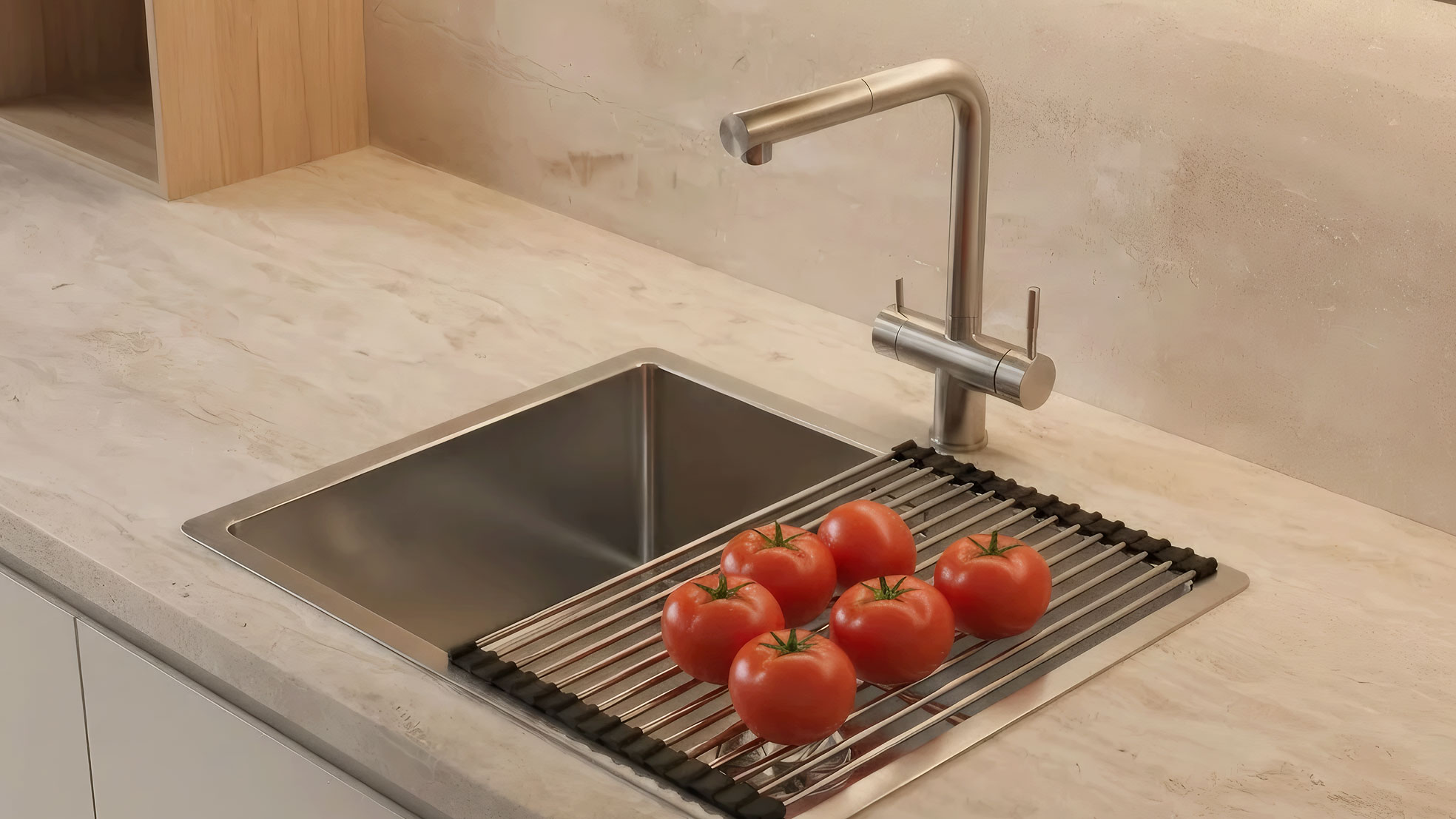
Roll-up wins on storage and quick deployment; lay-on wins on stability for heavy loads and built-in features. If storage space is tight, that alone usually settles the choice. If cast iron and heavy pots are a daily occurrence, rigidity matters more than how small it packs away.
FAQ
Can a roll-up drainer hold a heavy pot without bending?
Light to moderate loads are fine, but a concentrated heavy load, like a full cast iron pot around 4-5kg, can cause the bars to flex slightly. A rigid lay-on grid handles that same weight without sagging since it distributes load across the whole panel rather than a few bars.
How small does a roll-up drainer actually get for storage?
A standard-width roll-up (sized for a 35-45cm sink opening) coils to roughly 8-10cm in diameter and 30-35cm long, close to the size of a rolled magazine, which fits most kitchen drawers.
Do lay-on drainers hold water on their surface?
Some do, depending on design. Flat horizontal sections without a slight slope or drainage channel can hold small pools that need wiping, while round-bar roll-up drainers shed water immediately since there's no flat surface for it to sit on.
Which format is easier to clean?
Both are easy at the basic level and dishwasher safe in most cases. A lay-on drainer with an integrated utensil holder or multi-section design has more joints to check for buildup than a simple roll-up or a plain grid lay-on.
Can I leave either drainer on the sink permanently?
Yes, and many households do. Storage-size differences only matter if you actually remove the drainer between uses; deployed, both formats free identical counter space regardless of format.
What usually fails first on a roll-up drainer?
The flexible silicone connections between bars, since they take bending stress every time the drainer is rolled and unrolled. Thicker, reinforced connections last years longer than thin budget ones.
Is a lay-on drainer with a cutting board slot worth the extra cost?
It depends on how often you'd use the integrated feature. A rigid lay-on surface is genuinely more stable for cutting than flexible roll-up bars, but if you already have adequate counter prep space, a basic grid or a roll-up covers the core drying function at a lower price.
Which format is better for a small kitchen?
Roll-up, if drawer space is available; it's the only format that compresses small enough to fully clear the counter and cabinet interior. If drawer space is also limited, a lay-on drainer left permanently in place avoids the storage question entirely.


