
Too few pendants leave your island underlit and visually unbalanced. Too many create clutter and overwhelm the space. The right number depends on your island's dimensions, the pendant size you've chosen, and the overall proportions of your kitchen. Fortunately, straightforward calculations take the guesswork out of this decision.
This guide walks you through the formulas, considerations, and practical adjustments that ensure your island lighting looks intentional and performs beautifully.
The Basic Formula
The fundamental calculation for pendant quantity relates island length to pendant size and spacing.
Start with your island length in inches or centimetres. A typical kitchen island ranges from 180cm to 300cm, though smaller and larger examples exist. Measure the full length of the surface where pendants will hang above.
Next, determine your pendant diameter. Small pendants measure roughly 15-20cm across. Medium pendants fall in the 25-35cm range. Large pendants exceed 40cm. The size you choose affects both the number needed and the spacing between them.
The general spacing guideline is 60-75cm between pendant centres. This distance provides visual separation while maintaining a cohesive grouping. Closer spacing suits smaller pendants; wider spacing works for larger fixtures.
To calculate quantity, subtract 30-45cm from each end of the island for edge clearance, then divide the remaining length by your chosen spacing distance and add one.
For example, a 240cm island with 30cm edge clearance on each side leaves 180cm of hanging space. Divided by 60cm spacing gives you three pendants. Divided by 75cm spacing gives you two to three, depending on rounding.
Quick Reference by Island Length
While every situation has nuances, these general guidelines provide starting points for common island sizes.
150-180cm islands typically work best with two pendants. This length doesn't provide enough space for three fixtures without crowding, and a single pendant, even a large one, often looks insufficient over the elongated surface.
180-240cm islands suit either two or three pendants depending on fixture size. Larger pendants in the 35-45cm range work well as a pair. Smaller pendants in the 20-30cm range often look better as a trio.
240-300cm islands generally require three pendants. This length provides comfortable spacing for three medium to large fixtures, creating balanced visual rhythm across the surface.
300cm and longer islands may warrant four or even five pendants. Very long islands need additional fixtures to maintain appropriate spacing without leaving dark zones or visual gaps in the arrangement.
These guidelines assume pendants of moderate size. Choosing unusually small or large fixtures shifts the recommendations accordingly.
Pendant Size Selection
The size of individual pendants affects how many you need and how the overall arrangement reads in the space.
Small pendants (15-25cm diameter) work well in multiples. Their modest scale means you'll typically need more of them to create sufficient visual presence. Three small pendants over a medium island or four to five over a large island creates appealing rhythm without overwhelming the space.
Medium pendants (25-40cm diameter) offer the most flexibility. They provide substantial presence individually while still working in groups of two, three, or more depending on island length. This size range suits most residential kitchen islands.
Large pendants (40cm and above) make strong individual statements. Over shorter islands, a single large pendant might suffice. Over longer islands, two large pendants often provide better coverage than three medium ones. Large pendants require more spacing between them, which limits how many fit comfortably.
Linear fixtures designed specifically for islands follow different rules. These elongated pendants span significant length in a single fixture, often eliminating the need for multiples entirely. A 90-120cm linear pendant can replace two or three individual pendants while creating a distinctly different aesthetic.




The Two-Thirds Rule
A useful guideline for overall arrangement width is the two-thirds rule. The combined span of your pendant arrangement should cover approximately two-thirds of the island length.
For a 240cm island, this means your pendants, measured from the outer edge of the leftmost fixture to the outer edge of the rightmost, should span roughly 160cm. This proportion creates visual balance, anchoring the lighting to the island without extending beyond its edges.
The remaining third, split between the two ends, provides breathing room that keeps the arrangement from looking cramped or extending awkwardly over empty floor space.
Apply this rule after determining quantity and spacing. If your initial calculation produces an arrangement that spans more or less than two-thirds of the island, adjust spacing or reconsider fixture size to achieve better proportion.
Spacing Between Pendants
The distance between pendant centres significantly affects the arrangement's visual character.
Tighter spacing of 50-60cm creates a more unified grouping. The pendants read as a single compositional element rather than separate fixtures. This approach works well with smaller pendants and creates intimate, focused lighting over the work surface.
Standard spacing of 60-75cm balances unity and separation. Each pendant maintains individual identity while clearly belonging to the group. This range suits most applications and provides good light distribution.
Wider spacing of 75-90cm emphasises individual fixtures. Each pendant becomes more of a standalone element, which can work well with large or sculptural pieces that deserve individual attention. However, wider spacing may leave darker zones between fixtures.
Spacing should remain consistent across all pendants in the arrangement. Irregular spacing looks unintentional and disrupts the visual rhythm that makes multi-pendant installations effective.
Edge Clearance
How far the outermost pendants sit from the island ends affects both aesthetics and function.
Minimum edge clearance of 25-30cm prevents pendants from hanging over empty floor space. Fixtures extending beyond the island edge look disconnected and can interfere with movement around the island perimeter.
Standard edge clearance of 30-45cm provides comfortable visual margin. The pendants clearly relate to the island surface without crowding the edges. This range works for most installations.
Greater edge clearance of 45-60cm might be appropriate for very long islands or arrangements with few large pendants. The additional margin prevents fixtures from dominating the island ends and provides more open space at seating areas that often occupy island ends.
Consider how you use your island ends. If bar stools occupy one end, additional clearance there prevents pendants from hanging directly over seated diners, which can feel cramped. If the ends serve as work zones, slightly tighter clearance keeps light where you need it.
Accounting for Island Width
Island width matters more than many people realise.
Narrow islands of 60-75cm width suit smaller pendants. Large fixtures over a narrow island look disproportionate, overwhelming the surface visually. Scale pendant diameter to island width as well as length.
Standard islands of 90-110cm width accommodate the full range of pendant sizes. This width provides enough visual mass to support substantial fixtures without feeling overwhelmed.
Wide islands of 120cm and above can handle larger pendants and might even support double rows in certain configurations. However, most residential installations stick with a single row centred over the island, regardless of width.
A rough guideline suggests pendant diameter should not exceed one-third of island width. For a 90cm wide island, pendants up to 30cm work comfortably. Larger fixtures begin to dominate the width dimension.
Ceiling Height Adjustments
Your ceiling height influences both the pendant quantity calculation and how the arrangement reads visually.
Standard 2.4m ceilings work straightforwardly with the basic formulas. Pendants hang at standard height, and the arrangement relates naturally to both the island below and the ceiling above.
Higher ceilings of 2.7-3m allow larger pendants, which may reduce the quantity needed. A pendant that would overwhelm a standard-height room can breathe in a taller space. Consider sizing up and reducing quantity rather than using more small fixtures.
Very high ceilings above 3m create opportunities for dramatic pendant installations. Larger fixtures, longer drops, and potentially more pendants create impact appropriate to the grand proportions. The formulas still apply, but scaling up across all dimensions often produces better results.
Lower ceilings of 2.2-2.3m require careful fixture selection. Low-profile pendants maintain appropriate clearance without sacrificing style. Smaller fixtures and potentially fewer of them prevent the arrangement from dominating the compressed vertical space.
Considering Your Kitchen's Overall Size
The island exists within a larger kitchen context. Pendant quantity and size should relate to that context.
Compact kitchens with limited square footage call for restrained island lighting. Even if the island length supports three pendants, two might feel more appropriate in a smaller room. The goal is balanced proportion throughout the space, not maximum pendants per linear metre.
Large kitchens with generous proportions support more substantial installations. Three or four pendants that might overwhelm a compact kitchen feel appropriately scaled in an expansive space. The island lighting should hold its own against the room's overall volume.
Open-concept spaces add another dimension. When the kitchen flows into living and dining areas, island pendants become visible from throughout the combined space. They need sufficient presence to read from a distance while still relating appropriately to the island itself.
Functional Lighting Considerations
Aesthetics matter, but pendants also need to light your island effectively.
Task lighting for food preparation requires adequate illumination across the full work surface. If your pendant quantity leaves dark zones between fixtures, consider adding more pendants, choosing fixtures with broader light spread, or supplementing with recessed ceiling lights.
The type of pendant affects light distribution. Open-bottom pendants with exposed bulbs cast light downward efficiently. Enclosed pendants with translucent shades provide softer, more diffused illumination. Opaque shades that direct light only downward create dramatic pools but may leave gaps.
Bulb selection and dimming capability extend functional flexibility. Even if your pendant quantity creates adequate coverage at full brightness, the ability to dim for ambiance adds value. Ensure your chosen configuration provides both task-appropriate brightness and mood-setting options.
The Visual Test
Before finalising your decision, visualise the arrangement in your actual space.
Cut cardboard or paper circles to match your planned pendant diameter. Tape them to strings and hang them from your ceiling at the planned positions and height. Step back and evaluate.
Walk around the island. Sit at any bar stools. Look from the kitchen entry, from the adjacent rooms if open concept, from the sink and stove positions. Does the arrangement feel balanced? Does it relate appropriately to the island? Does it suit the room's overall proportions?
This simple test often reveals issues that calculations alone miss. The pendants might cluster too tightly, leaving island ends in shadow. They might spread too widely, losing their sense of grouping. The overall span might not achieve the two-thirds proportion. Adjustments at this stage cost nothing and prevent expensive mistakes.
Common Configurations
Certain arrangements appear repeatedly in successful kitchen designs.
Two pendants work over shorter islands and suit larger fixtures. Position them equidistant from centre, maintaining appropriate edge clearance. This configuration feels balanced and provides good coverage without complexity.
Three pendants remain the most popular configuration for medium and longer islands. The centre pendant anchors the arrangement while the outer pendants frame it. This odd number creates pleasing visual rhythm with a clear central focus.
Four pendants suit very long islands where three would space too widely. Even numbers lack the central anchor of odd numbers, which can feel less resolved. However, over sufficient length, four pendants create strong rhythm and excellent coverage.
Five or more pendants work only over exceptionally long islands or in commercial settings. Residential kitchens rarely require more than four individual pendants. If calculations suggest five, consider whether larger fixtures in smaller quantity might work better.
Single linear fixtures offer an alternative to multiple pendants. A well-proportioned linear pendant can span much of the island length in one piece, creating clean, unified appearance. This option suits minimalist aesthetics and simplifies installation.
Calculator Summary
To determine your pendant quantity:
Measure island length in centimetres. Subtract 60-90cm total for edge clearance (30-45cm each end). Divide the remaining length by your planned spacing (60-75cm between centres). Add one to get pendant quantity.
Example: 270cm island minus 60cm clearance equals 210cm. Divided by 70cm spacing equals 3. Add one equals 4 pendants. Or with 75cm spacing: 210 divided by 75 equals 2.8. Round to 3, add one equals 4, or round to 2, add one equals 3 pendants.
Verify that total arrangement span achieves approximately two-thirds of island length. Adjust spacing or quantity if needed.
Confirm pendant diameter suits both island width and ceiling height. Adjust fixture selection if proportions feel wrong.
Test visually with mock-ups before purchasing and installing.
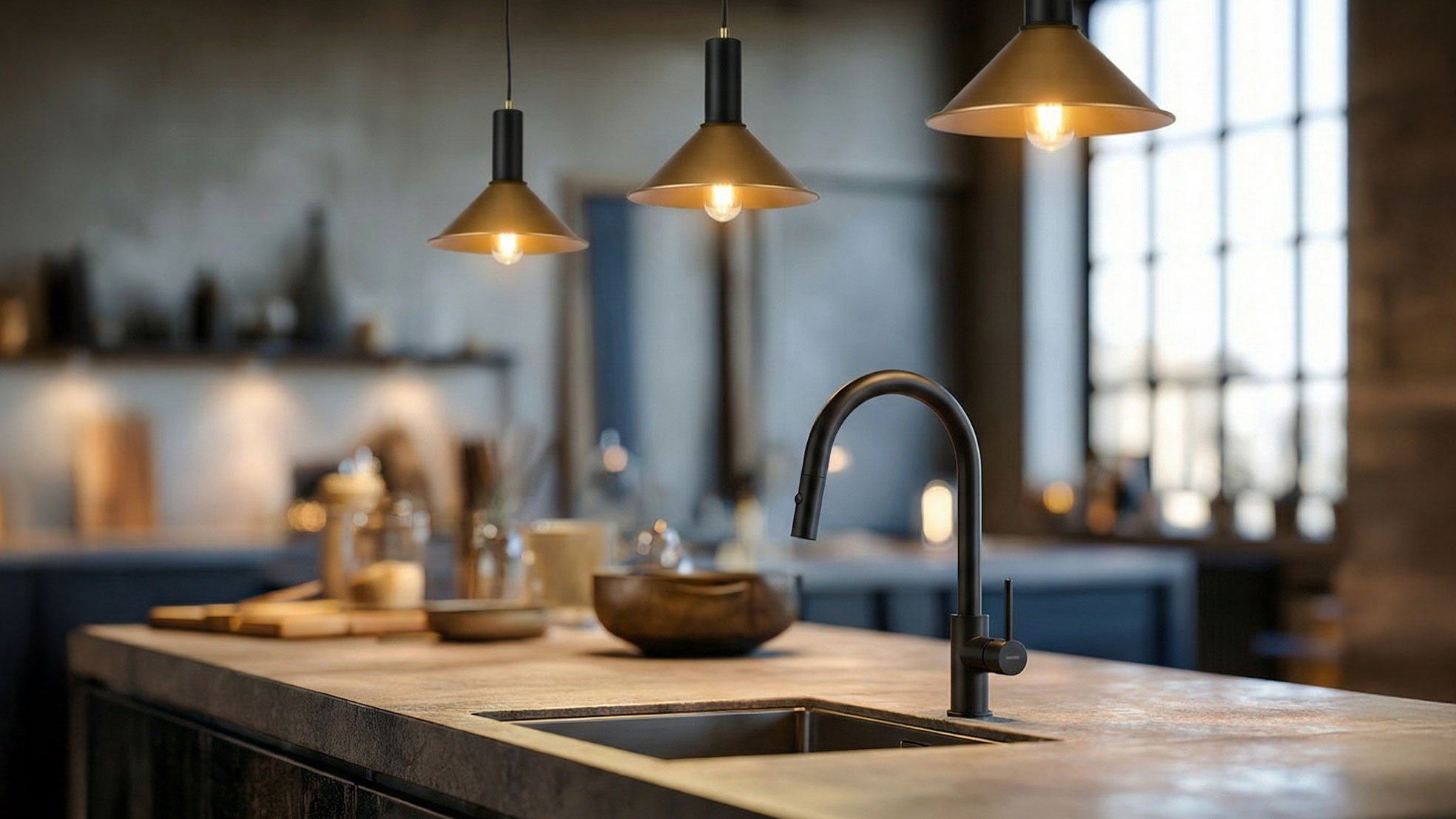
Calculating pendant quantity for your kitchen island combines straightforward mathematics with design judgment. The formulas provide starting points, but your specific space, fixtures, and preferences determine the final decision.
The goal is an arrangement that looks intentional and performs effectively. Pendants should relate clearly to the island below, provide adequate light for tasks, and contribute to the kitchen's overall design. Too few fixtures leave gaps; too many create clutter. The right number balances these concerns.
Take time with this decision. Mock up your planned arrangement. Live with it visually for a few days before committing. The effort invested in getting the quantity right pays off every time you use your kitchen.


